Categories
Phuket Vegetarian Festival – What to expect, rituals & tips for your visit
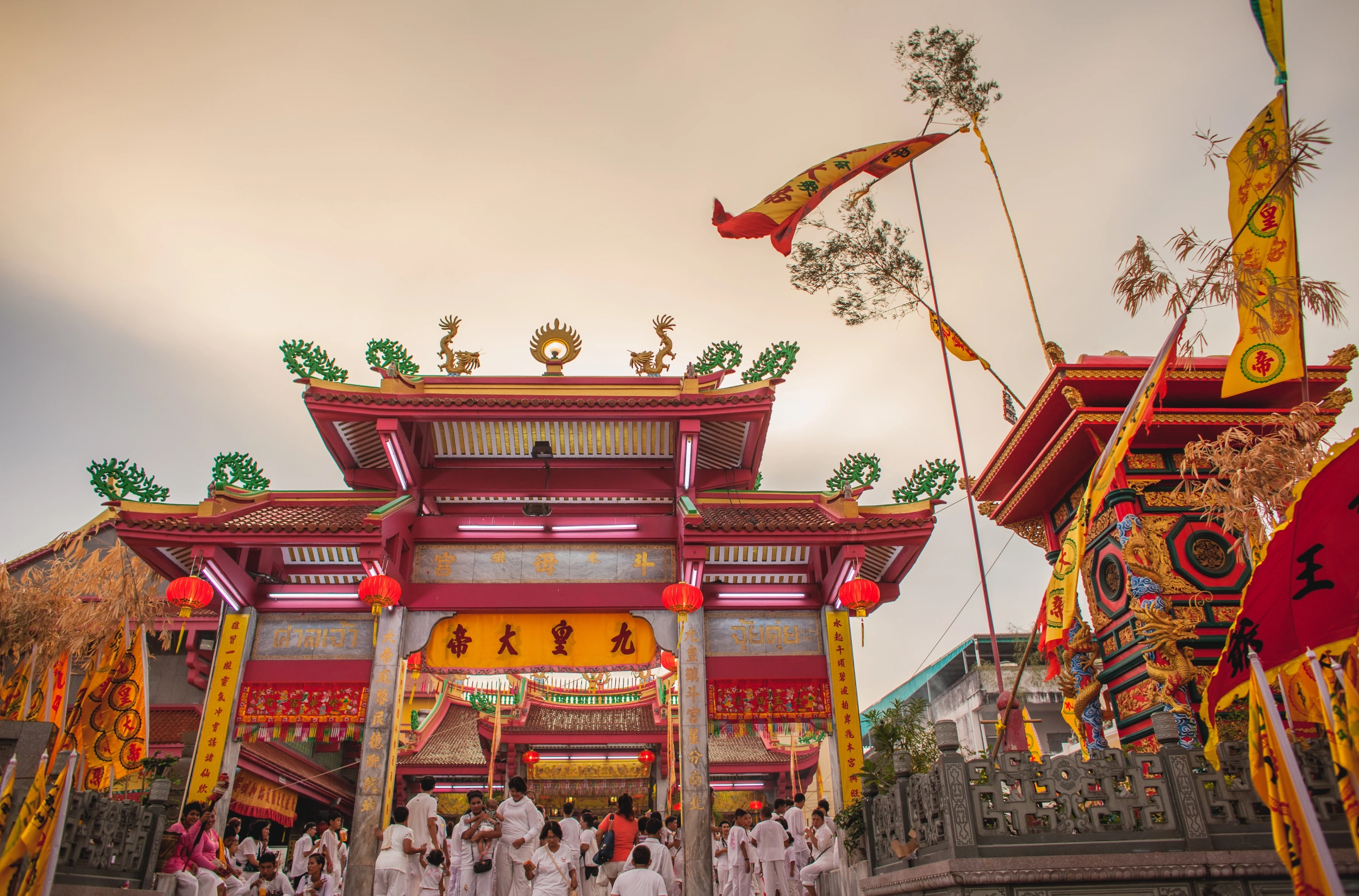
During the Phuket Vegetarian Festival, Phuket Town changes noticeably for several days. Chinese shrines become centers of religious ceremonies, major processions move through the streets and vegetarian food stalls appear around many of the main festival areas. Firecrackers and ritual body piercings are also part of a tradition that goes far beyond what the name “Vegetarian Festival" might initially suggest.
There are several ways to experience the festival. A few hours in Phuket Town are enough for a first impression. If you want to see one of the major morning processions and attend a shrine ceremony later in the day, it is worth setting aside a full day. If you are already staying in Phuket, one well-chosen event can be enough to give you a good sense of the festival.
Is the Phuket Vegetarian Festival worth visiting?
The festival offers a glimpse into a part of local life that can easily remain out of sight during a typical beach vacation. Thai-Chinese families, shrines and entire neighborhoods take part, bringing religious traditions, everyday life and food together throughout the festival.
For travelers interested in local culture or already planning to spend time in Phuket Town, it is worth experiencing even without any prior knowledge of the traditions. Visiting a shrine, trying the food stalls and watching one of the larger street processions already reveals several very different sides of the festival.
How intense the experience feels depends largely on what you choose to see. The major street processions involve firecrackers, smoke, crowds and visible body piercings. For a gentler introduction, focus on a shrine visit, the food stalls and Phuket Old Town.
When does the Phuket Vegetarian Festival take place?
The Phuket Vegetarian Festival follows the Chinese lunar calendar and is celebrated during the ninth lunar month each year. On the Gregorian calendar, this usually falls in September or October.
Current dates for 2026: The Phuket Vegetarian Festival takes place from October 10 to 18.
The main religious period lasts nine days, although preparations and opening ceremonies may begin shortly beforehand. One important detail for planning is that the participating shrines follow their own programs, so dates, procession routes and individual rituals are set again each year.
The participating shrines and official local sources publish the latest ceremony times and procession routes. Because the schedule changes each year, it is best to check it again shortly before your visit.
Many of the larger street processions begin early in the morning, sometimes before sunrise. Firewalking and other major shrine ceremonies often take place in the evening, depending on that year's schedule. If you are planning a trip specifically around the festival, check the exact dates before booking your hotel. If you are already in Phuket, you will usually only need the current schedule for the day you want to attend.
What happens during the Phuket Vegetarian Festival?
The festival is not a single event held in one place. Over several days, religious processions, prayers, offerings and ceremonies take place at Chinese shrines across Phuket. For visitors, the easiest way to understand the festival is by looking at how a typical day unfolds.
Major processions take place in the morning
The best-known processions begin at one of Phuket's Chinese shrines before moving through different parts of Phuket Town. Families and local businesses prepare small roadside altars with offerings. Religious images are carried through the streets while firecrackers accompany parts of the procession.
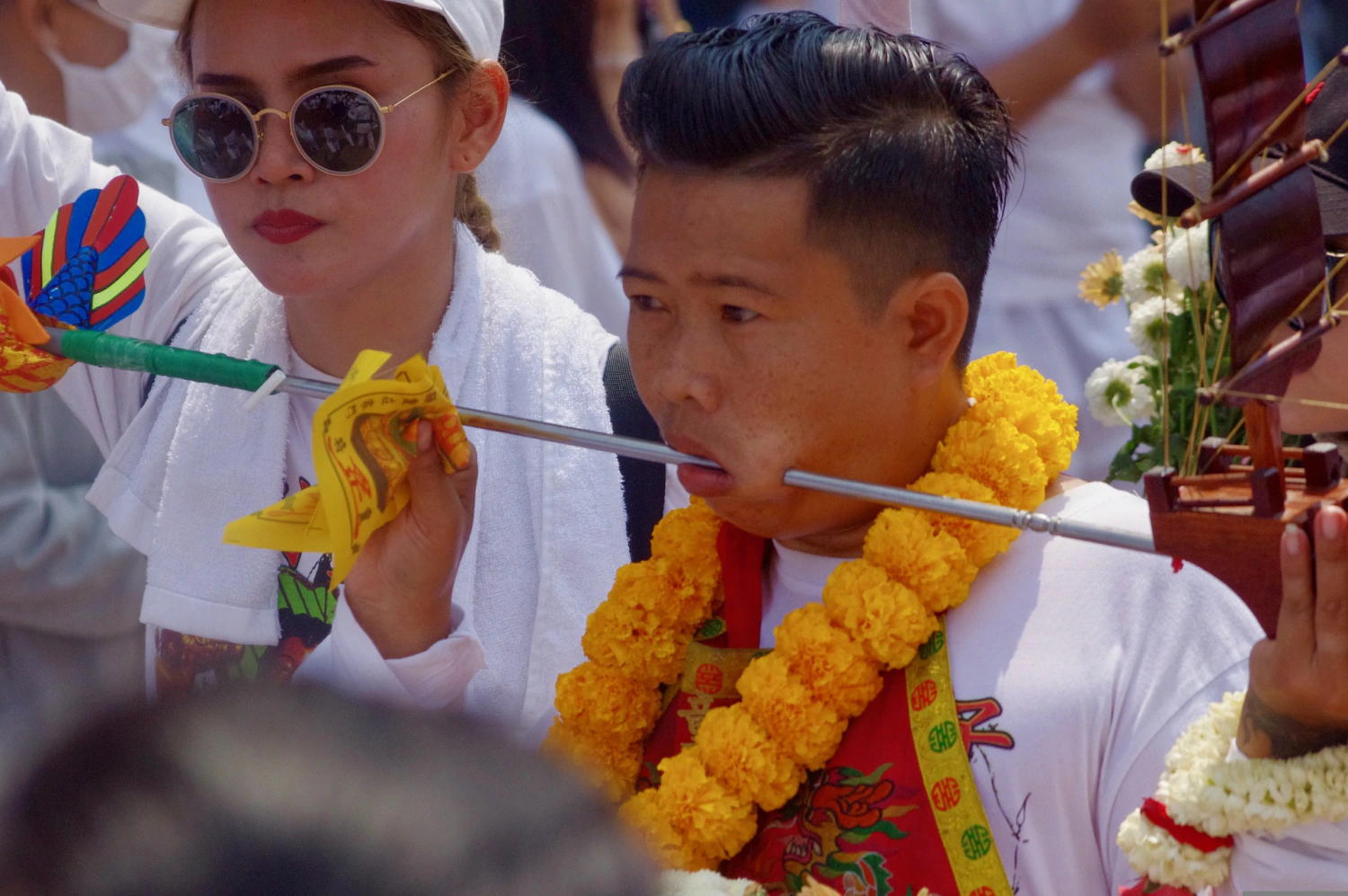
Among the most striking participants are the Ma Song, spiritual mediums within the religious tradition. Some pierce their cheeks with metal rods, blades or other objects. For worshippers, these rituals carry religious meaning and are not performances staged for visitors.
Depending on the day, large crowds can gather along the procession routes. You can still follow what is happening from a little farther back.
Between processions, shrines and food take center stage
Outside the major street events, much of the activity shifts back toward the Chinese shrines and the surrounding streets. Worshippers arrive to pray and bring offerings while yellow flags and vegetarian food stalls become a familiar sight around the main festival areas.
A good starting point is Jui Tui Shrine on Ranong Road. From there, you can continue toward Phuket Old Town, making the shrine, festival food and historic streets part of the same day.
More shrine ceremonies take place in the evening
Depending on the annual schedule, individual shrines host additional religious rituals in the evening. These can include firewalking, ceremonial bridge crossings and climbing ladders fitted with blades.
If there is a particular ceremony you want to see, choose the shrine based on its current program. Trying to move spontaneously between several locations is rarely the best use of your time.
The final night brings the festival to Saphan Hin
At the end of the festival, religious processions from several shrines move through Phuket Town toward Saphan Hin, a large waterfront park southeast of Phuket Old Town. The Kio Thian Keng Shrine, located directly by the sea, plays an important role in the ceremonies marking the departure of the deities.
The final night is one of the most intense stages of the festival. Large crowds, constant firecrackers and heavy smoke shape the atmosphere along parts of the route well into the evening.
Which side of the festival is right for your visit?
For a first visit
Jui Tui, Ranong Road and Phuket Old Town offer the most flexibility. A shrine visit, vegetarian food and, depending on the day's schedule, one of the larger processions can all be experienced within the same area. For a first impression, around two to four hours is a sensible amount of time.
For one of the major street processions
If you want to experience the festival at its most intense, choose a day when one of the major shrines is holding its procession. Jui Tui, Bang Neow and Kathu regularly serve as important starting points. An early start is worthwhile. Firecrackers, smoke, Ma Song and larger crowds are much more prominent during these events.
For an evening ceremony
If you want to see firewalking or another shrine ritual, plan your visit around the current schedule of one particular shrine. A morning event and an evening ceremony can also be combined in one day. In between, there is time for Phuket Old Town, food or a longer break.
For food and Phuket Old Town
If you are mainly interested in the atmosphere of the festival and its vegetarian food, combine a day in Phuket Old Town with a shrine visit and the stalls around Ranong Road. You do not need to plan around a specific ritual for this option, which makes it particularly easy to add spontaneously to a day you were already planning to spend in Phuket Town.
For the final night
If you specifically want to experience the last evening of the festival, plan for both Phuket Town and Saphan Hin. Crowds, traffic and the later hours make this part of the festival worth preparing for more carefully than a daytime visit.
Where is the best place to experience the Phuket Vegetarian Festival?
Numerous Chinese shrines across Phuket take part in the festival. For most visitors, however, a handful of locations is enough to experience its most important sides.
Jui Tui Shrine
Jui Tui Shrine sits on Ranong Road at the edge of Phuket Old Town and is one of the festival's main centers. Prayers and ceremonies take place here throughout the festival and one of the major processions also begins at the shrine. Ranong Road is home to one of the largest concentrations of vegetarian food stalls during the festival.
For visitors, the location is particularly convenient. The festival and Phuket Old Town can easily be combined without long transfers between them.
Bang Neow Shrine
Bang Neow Shrine is located on Phuket Road southeast of Phuket Old Town. Major street processions also begin here while additional religious ceremonies take place at the shrine depending on the annual schedule. Vegetarian food becomes much more prominent along Phuket Road during the festival as well.
Bang Neow is especially worth considering when a procession or ceremony you want to see is scheduled there on the day of your visit.
Kathu Shrine
Kathu Shrine lies inland between Phuket Town and Patong. Kathu has a close historical connection to the Vegetarian Festival and, according to local tradition, is considered the place where the festival began in Phuket. It continues to host its own religious ceremonies and festival events today.
From Phuket Town or the west coast beaches, the easiest way to reach Kathu is by taxi, private driver or your own vehicle. It is therefore better treated as a dedicated destination than as part of a day spent walking around Phuket Town.
Kio Thian Keng Shrine
Kio Thian Keng Shrine sits directly on the waterfront in Saphan Hin Park. Its most important role comes toward the end of the festival when ceremonies are held to send off the deities.
Saphan Hin does not need to be part of a first visit. For travelers specifically interested in the closing phase of the festival, however, it becomes one of the central locations.
How to plan your visit
Do you need to stay overnight in Phuket Town?
For a first visit, staying overnight in Phuket Town is not necessary. If you are based in Patong, Kata, Karon, Kamala, Bangtao or another part of Phuket, the festival works well as a day trip.
A night in town becomes more useful if the festival itself is a major part of your trip. If you want to start very early and attend an evening ceremony on the same day, staying nearby avoids making the journey between the beach areas and Phuket Town twice.
It can also be convenient for the final night. Staying in or around Phuket Old Town keeps travel times shorter.
Our selection of the best Hotels in Phuket can help you choose a well-located base for visiting the festival.
How do you get to Phuket Town from the beach areas?
For most visitors, a taxi or private driver is the simplest option. On major festival days, some roads in Phuket Town may be temporarily closed or difficult to access, so asking to be dropped directly at the shrine is not always the most practical approach.
A meeting point outside the busiest streets can work better, with the final part of the journey completed on foot.
Is the Phuket Vegetarian Festival free to attend?
The public processions and many shrine ceremonies are free to attend. Your main costs will be transportation, food and, if needed, accommodation. Donations at the shrines are welcome but not required for visitors.
Who are the Ma Song?
The Ma Song are spiritual mediums and among the best-known participants in the Phuket Vegetarian Festival, which is closely connected to the wider Nine Emperor Gods tradition. According to the beliefs of the community, they serve as mediums for deities during certain rituals. The term is often loosely translated as “horses of the gods."
During the festival, some Ma Song pierce their cheeks with metal rods, blades or other objects. Firewalking and other physical trials are also connected to their religious role. For worshippers, these acts are expressions of devotion and spiritual protection. They are part of a religious tradition rather than a spectacle created for visitors.
The piercings of the Ma Song dominate many international images of the festival, but they represent only one part of it. Prayers, offerings, the shrines and religious dietary practices are equally central to the tradition.
What does Jay mean and what can you eat during the festival?
During the festival, yellow flags with red lettering appear throughout Phuket Town. They mark stalls, restaurants and businesses serving food prepared according to Jay dietary rules. Jay means more than simply eating vegetarian food: The diet forms part of the religious purification practiced during the festival.
Animal-derived ingredients are traditionally avoided. Certain strongly scented plants, including garlic and onions, are also generally excluded from traditional Jay cooking.
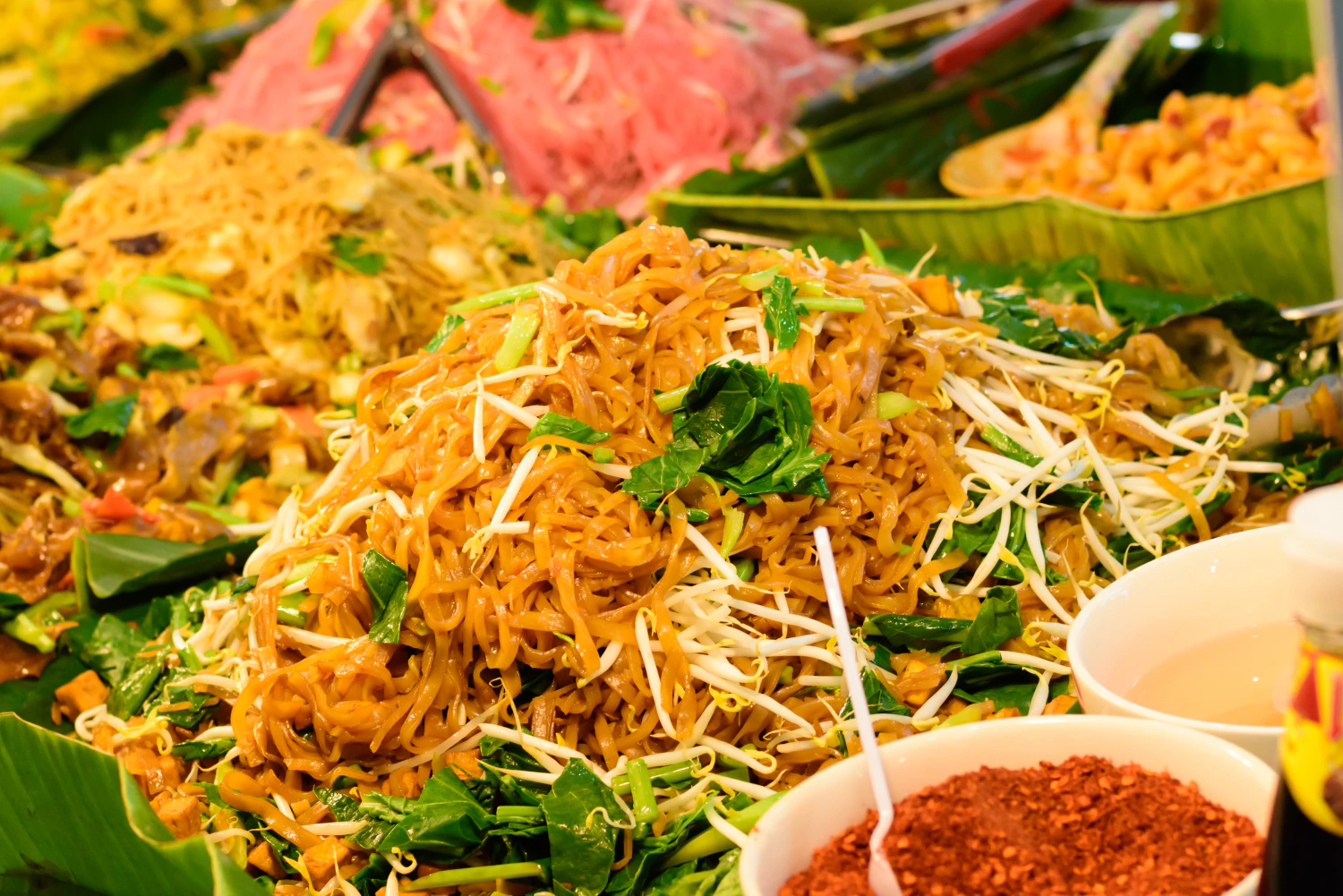
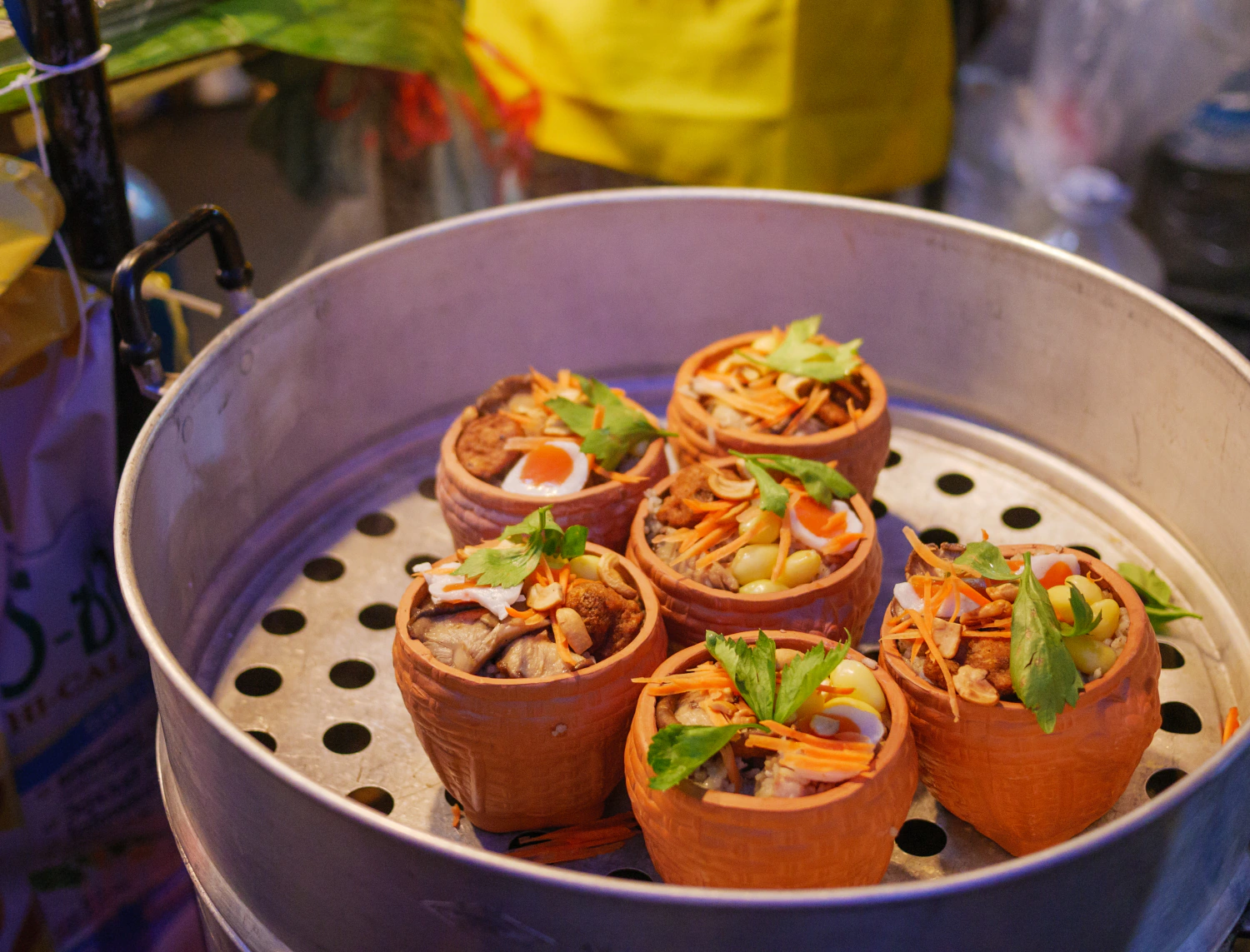
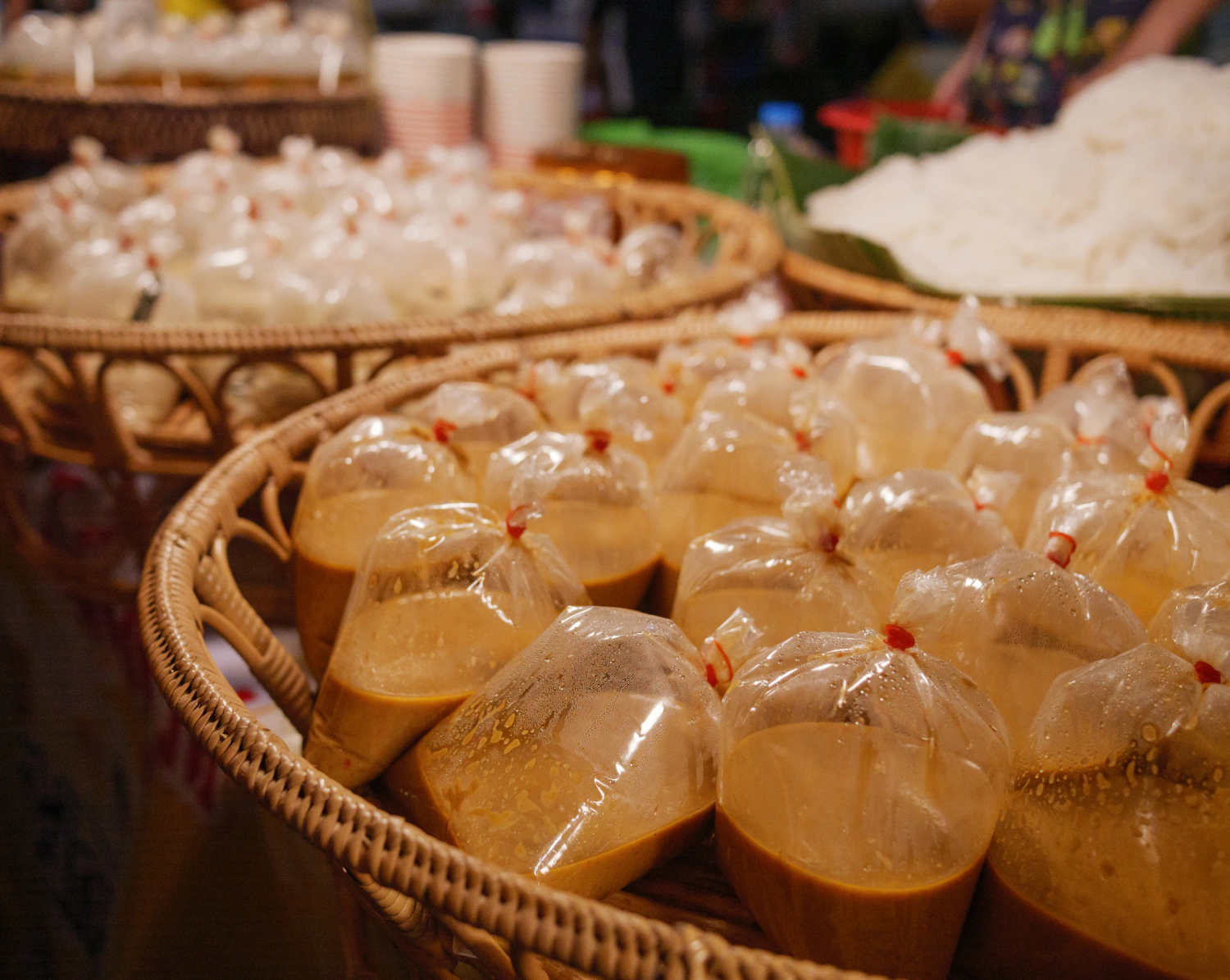
For visitors, Ranong Road around Jui Tui Shrine is one of the most interesting places to try a range of dishes. Temporary food stalls line the area throughout the festival while the selection also expands around Bang Neow and along Phuket Road. Typical dishes include fried noodles, curries, rice dishes, tofu and mushrooms, spring rolls, Khanom Jeen, sweets and plant-based versions of various meat dishes.
Jay is fundamentally plant-based, but it is not simply another word for vegan. Its religious rules go further in certain respects. If you follow a strict vegan diet, have allergies or need to avoid particular ingredients, it is still worth asking at individual stalls, especially when it comes to drinks, desserts and more contemporary dishes. Visitors do not need to follow Jay dietary rules themselves, but the food stalls are nevertheless one of the easiest ways to experience the festival atmosphere in Phuket Town.
What should you know before visiting?
Clothing and behavior
Many people actively participating in the festival wear white as a symbol of religious purity. Visitors are not expected to follow this tradition. When entering a shrine, modest clothing is appropriate, with shoulders and knees covered. Keep pathways clear for religious groups and avoid touching offerings or ceremonial objects.
Photography
Public events can be photographed, but discretion is appropriate during prayers, while Ma Song are preparing for rituals and when taking close-up photographs of individuals.
Firecrackers and smoke
Firecrackers can be extremely loud at close range. Smoke and incense can also build up along busy procession routes.
If you are sensitive to loud sounds, consider bringing ear protection or watching from a little farther away. Closed shoes are also useful as fragments from firecrackers can remain on the streets after larger processions.
Visiting the Phuket Vegetarian Festival with children
With young children, we recommend focusing on a shrine outside the busiest procession times, the food areas or a few hours around Phuket Old Town. The major processions combine loud noise, smoke, crowds and visible body piercings. With older children, it is easier to plan for these events while keeping some distance from the procession route.
What is the history behind the Phuket Vegetarian Festival?
The festival is closely connected to Phuket's Chinese heritage and the worship of the Nine Emperor Gods. Many Chinese families came to Phuket during the island's tin-mining era and had a lasting influence on its culture, architecture and religious life. The Chinese shrines found in Phuket Town and elsewhere on the island remain visible reminders of that history.
There are several different accounts of how the Vegetarian Festival began.
One of the best-known stories tells of a Chinese opera troupe that became ill in Kathu during the 19th century. According to the story, its members returned to religious practices and adopted a meat-free diet in honor of the Nine Emperor Gods, after which they recovered.
Other versions refer more generally to an epidemic within the Chinese community at the time. The exact historical sequence can therefore no longer be established with certainty.
Today, the festival continues to bring together religious purification, prayer, offerings, dietary practices and communal rituals. The body piercings of the Ma Song are part of this much broader tradition maintained by Phuket's Chinese shrines and their communities.
More ideas for Phuket
For more ideas around the island, our Phuket Guide shows how to combine Phuket Town with the beaches, different areas and other experiences across Phuket.
Phuket Town takes on a completely different character during Songkran. Instead of religious rituals, the Thai New Year brings water, street celebrations and a very different kind of energy to the city. Read more in our article on Songkran in Thailand.
How to experience the Phuket Vegetarian Festival
For a first visit, choosing one clear focus works better than trying to see as many festival locations as possible. The area around Jui Tui and Ranong Road offers one of the easiest introductions and can be combined naturally with Phuket Old Town.
If you want to experience more, choose a specific evening ceremony or the closing phase of the festival based on the current schedule. Trying to fit several shrines into the same day usually adds little to the experience.